
Positioning
NeuralSceneBridge is a reconstruction bridge for downstream simulation. It turns a recorded scene, sensor streams, and dynamic actor tracks into a pinned NuRec/USDZ artifact, then serves that artifact through NVIDIA SensorsimService for reproducible RGB/LiDAR observations and controlled edits.
The current delivery is open-loop: a fixed scene and trajectory go in, reproducible renders and diagnostics come out. It is the reconstruction and renderer side of a larger simulation system. ClosedLoopBench consumes the handoff and owns the CARLA synchronous clock, ego/actor execution, control boundary, and evaluation loop.
Bottom line: the final RGB/LiDAR result is not physically aligned yet.
status: passedin V04 means that 385 render windows and the capture gate completed; it does not mean world-frame consistency or per-actor point ownership passed.
Reconstruction Handoff
The project produces three downstream-facing outputs: a versioned USDZ scene, a sensor RPC contract with logical-window timestamps and coordinate frames, and reviewable frame/video evidence. The artifact is useful for RGB replay, actor editing, camera probes, and integration plumbing today. Reconstructed LiDAR is kept as a diagnostic input until it passes the downstream actor-aware gate.
NeuralSceneBridge owns reconstruction, artifact identity, and renderer
evidence. ClosedLoopBench owns the observation boundary, CARLA clock, agent
runtime, and closed-loop evaluation. The full boundary is recorded in
docs/downstream_simulation_handoff.md.
What is actually proven
| Case | Operation | Retained evidence | Claim boundary |
|---|---|---|---|
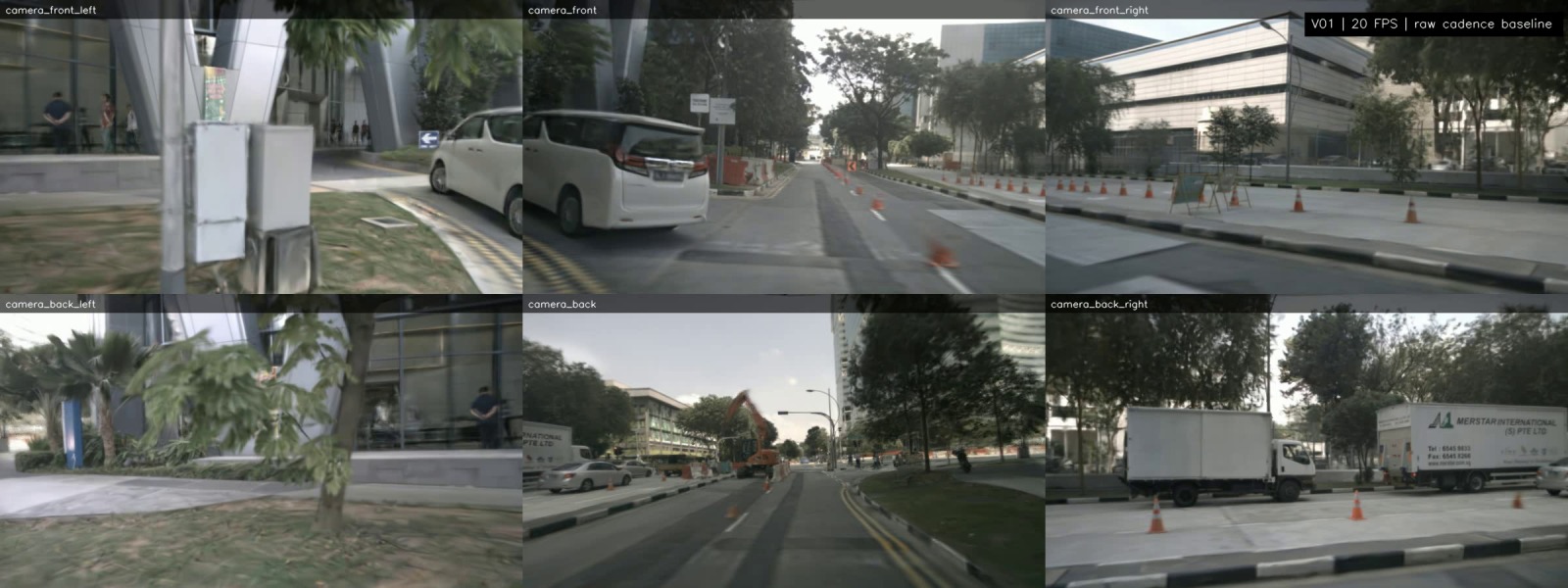
| V01 | Original trajectory replay, six cameras in a 3x2 grid | 20/30 FPS videos, 385 frames, zero dropped frames | Scene and sensor requests are reproducible |
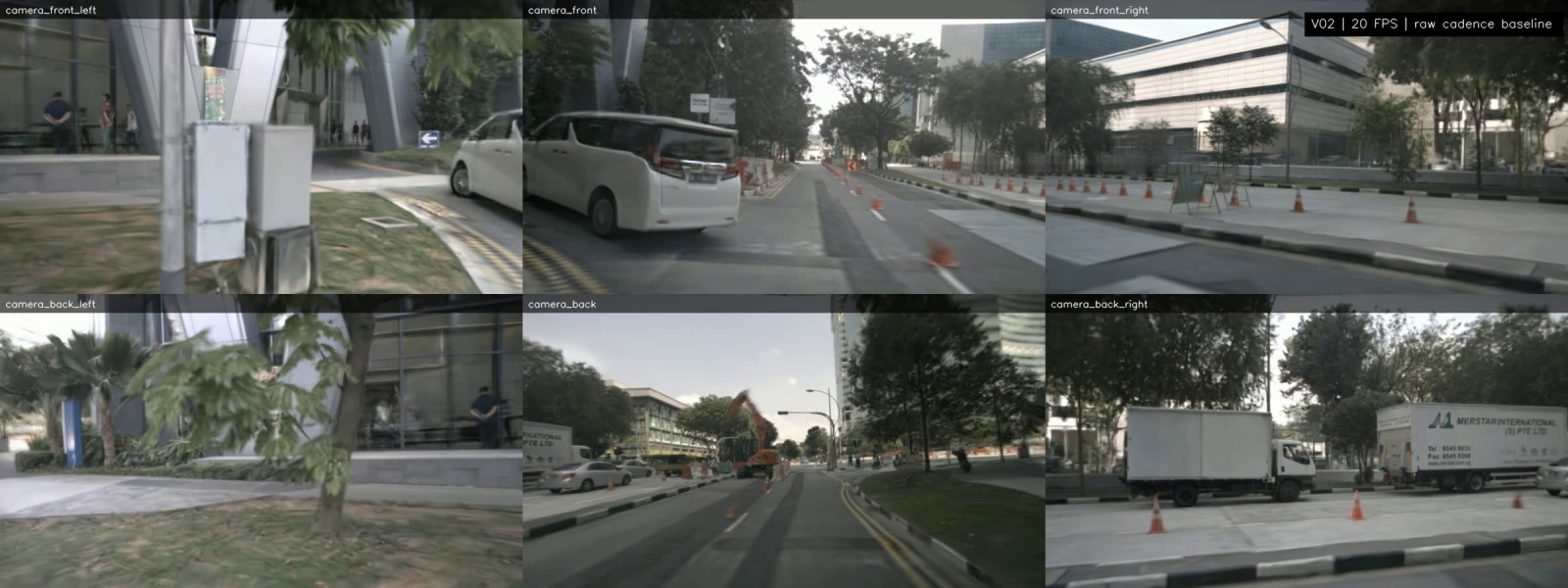
| V02 | Translate track c1958768... by +0.5m in the world frame |
A/A/B request digest, RGB repeatability, target-only change | Dynamic edits reach the RGB response; non-target digest stays unchanged |
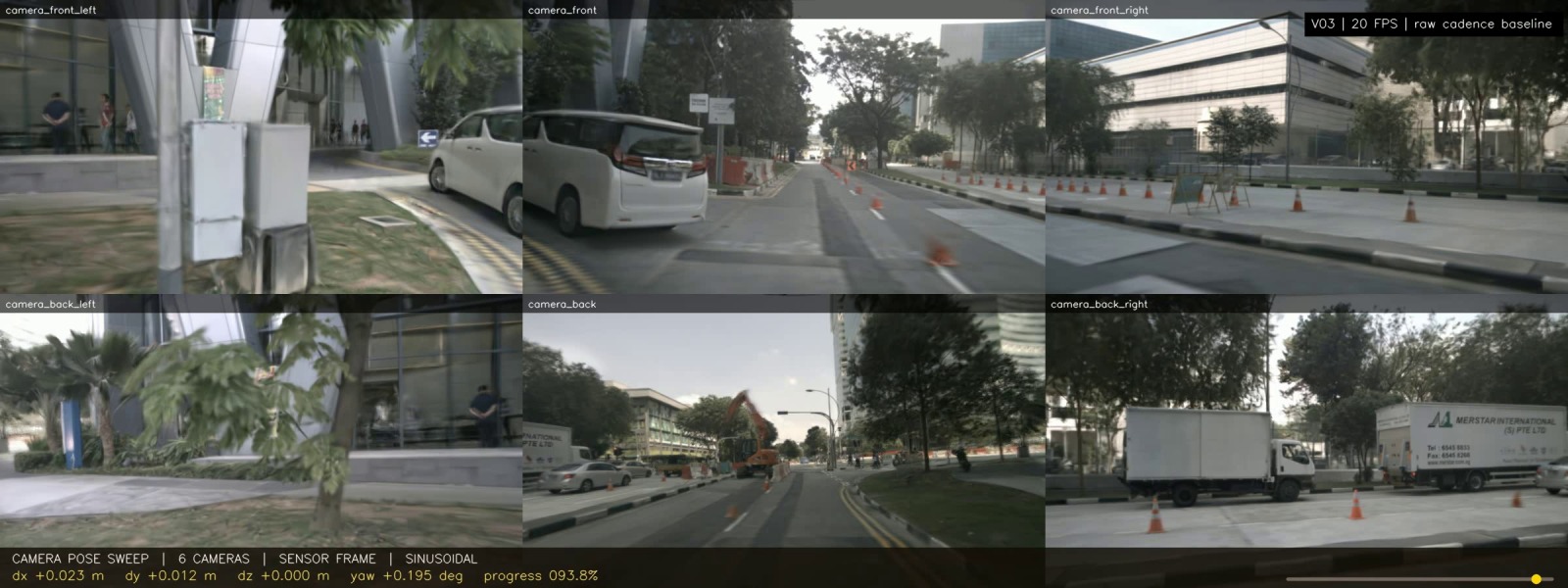
| V03 | Bounded camera sweep: x=0.12m, y=0.06m, yaw=1.0° |
Probe summary, pose readout, trajectory extrema | Camera pose control is measurable and replayable |
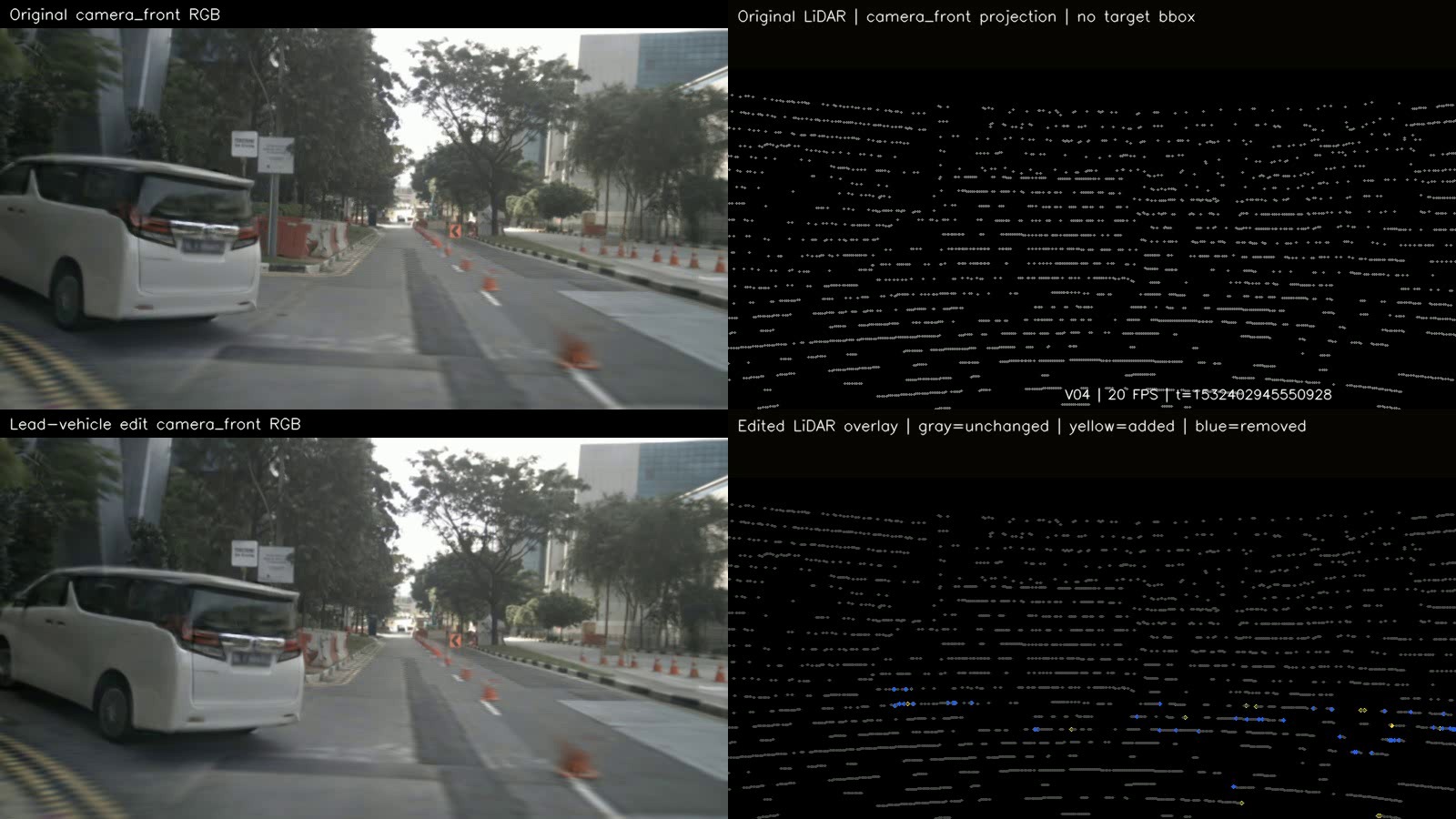
| V04 | Original/edited RGB and LiDAR in a four-panel view | Same logical-window renderer evidence | Canonical v2b view is a diagnostic; no A/A control or physical alignment is claimed |
Viewer evidence
These images are stills extracted from the final playback videos. All four
stills use playback frame 360/385 from the same 20 FPS sequence, so the scene
state is directly comparable across V01, V02, V03, and V04. The camera labels,
case labels, and V03 pose readout are retained so the request-to-render-to-
evidence relationship is visible in one glance.
V04: turning “not aligned” into a diagnosis
The M8 open-loop record in ClosedLoopBench breaks the investigation into falsifiable steps instead of jumping straight to “the coordinates are wrong”:
| Layer | Check | Conclusion |
|---|---|---|
| Request | The same dynamic_objects payload changes RGB at the true target pixels |
The client-side track_id + pose_pair path is valid |
| Coordinates | Correct the old NuRec LiDAR axis matrix, then compensate the measured -1m sensor-height offset |
The transform fixes are real, but do not explain the remaining collapse |
| Modality isolation | NRE RGB + raw LiDAR recovers detections; raw RGB + NRE LiDAR remains at 0 matches and mAP50 0 |
RGB is not the main bottleneck; reconstructed LiDAR is |
| Server A/B | target-only / empty / all-minus-target produce essentially the same returns near the true ROI; 34.7m and 100m target poses produce the same 136 extra cells | The NuRec 26.04 dynamic LiDAR path does not apply the per-track cuboid pose correctly |
The live probe is more specific: RGB follows the requested target pose, while most vehicles contribute no LiDAR returns at their true positions. Rendering a vehicle alone produces a fixed scatter roughly 12m forward. The ClosedLoopBench diagnosis is that the NRE 26.04 server-side dynamic LiDAR renderer, or a checkpoint/runtime convention mismatch, places dynamic Gaussians near canonical_position + lidar_extra_signal without applying each track’s cuboid transform before raycasting. Until NVIDIA confirms the implementation, this page calls it a server-path diagnosis/upstream limitation rather than a repaired product bug.
The detailed evidence is retained in ClosedLoopBench/docs/open_loop_m8_debug_log.md and the forum-ready report nurec_lidar_dynamic_bug_report.md.
For downstream simulation, this means the reconstructed scene is currently renderer-usable but not perception-ready as a coherent RGB/LiDAR sensor stream. A mixed test where NRE RGB is paired with raw LiDAR is useful for causal attribution, but it is not a production sensor route.
Engineering boundary
- Completed: reconstruction artifact identity gates, 223-track inventory validation, V01/V02/V03 rendering, V02 A/A/B repeatability, V03 bounded camera probing, and V04 renderer evidence.
- Not completed: source-timestamp-faithful full-dynamic replay, true RGB/LiDAR actor ownership, perception-grade reconstructed LiDAR, or a CARLA closed-loop score.
- Explicitly not claimed: NeuralSceneBridge does not own CARLA
world.tick()and does not claim that an ego vehicle brakes, avoids, or changes its next trajectory from these renders.
The next integration step is a shared timestamp, coordinate-frame, sensor-pose, and actor-binding contract. ClosedLoopBench can then own the CARLA synchronous clock and rerun its same-frame actor-aware bbox gate. If the upstream dynamic LiDAR path remains unresolved, the next experiment is a denser lidar-sweeps reconstruction or a new checkpoint, not another unverified downstream coordinate patch.
Code map
demo/scene0061/manifest.json: canonical USDZ/checkpoint, scene interval, target track, and runtime identity.demo/scene0061/cases/: V01 original replay, V02 lead-vehicle edit, and V03 camera-pose sweep.scripts/render_counterfactual_video.py: sends per-caserender_rgbrequests and builds evidence-backed six-camera videos.scripts/: the canonical V04 RGB/LiDAR capture and difference overlay.render_multimodal_alignment_video_v2b.py docs/downstream_simulation_handoff.md: reconstruction-to-simulation ownership and acceptance boundary.scripts/generate_nurec_quality_report.py: binds artifact, case, frame, video, and quality metrics into the formal report.nurec_scene0061_final/: local playback delivery; videos, USDZ, checkpoint, and raw data stay out of Git.